Six Ways to Improve Your Site’s Google Search Optimisation

Kyle Eggleston
Chicago SEO Consultant since 2004LinkedIn

On this page
- Why Google Search Optimisation Can Make or Break Your Business
- Understanding Google Search Optimisation in 2026
- Way 1: Build a Clear Site Structure and Descriptive URLs
- Way 2: Publish High-Quality, Non-Commodity Content
- Way 3: Master Technical SEO and Mobile-Friendliness
- Way 4: Optimize for AI Search and Generative Engines
- Way 5: Monitor Performance with Google Search Console
- Way 6: Promote Your Website Compliantly
- Frequently Asked Questions about Google Search Optimisation
- Conclusion
Why Google Search Optimisation Can Make or Break Your Business
Google search optimisation is the process of improving your website so it shows up higher in Google’s results — and attracts the right visitors without paying for ads.
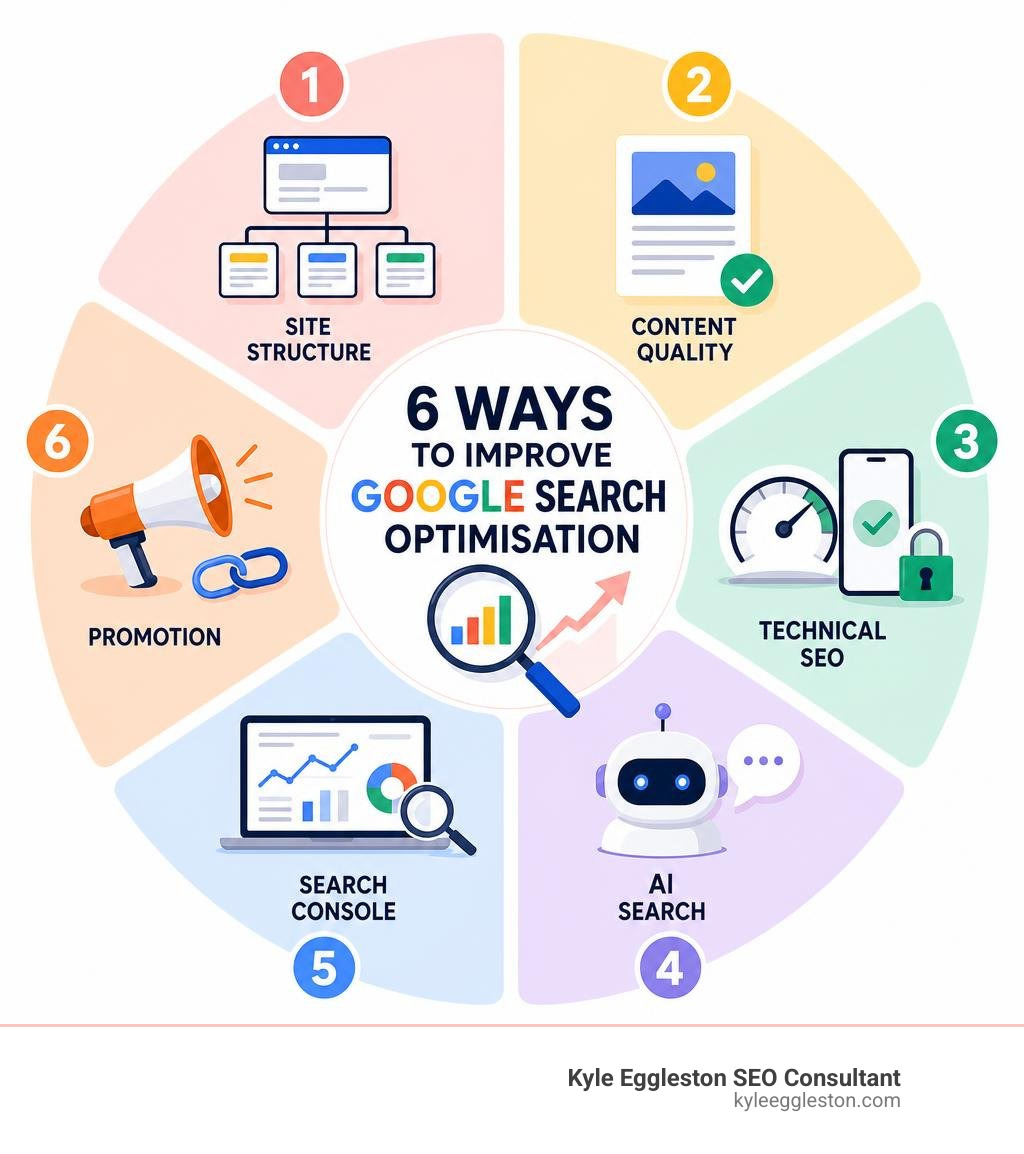
Here are the six core ways to do it:
- Build a clear site structure and descriptive URLs — make it easy for Google to crawl and understand your pages
- Publish high-quality, non-commodity content — write for real people, not just algorithms
- Master technical SEO and mobile-friendliness — fast, secure, mobile-ready sites rank better
- Optimize for AI search and generative engines — get cited in AI Overviews and Google’s AI Mode
- Monitor performance with Google Search Console — track what’s working and fix what isn’t
- Promote your website compliantly — build real links and authority without risking penalties
Google processes over 8.5 billion searches every single day. That’s 8.5 billion chances for someone to find your business — or find your competitor instead.
If your website isn’t optimized for Google, you’re invisible to most of them.
The good news? You don’t need a massive budget or a technical degree to fix that. You need the right strategy.
That’s exactly what this guide covers — six practical ways to improve your visibility in Google Search, written for small business owners who want real results.
I’m Kyle Eggleston, an SEO and AI technology consultant who has helped enterprises and small businesses improve their google search optimisation to drive more leads and revenue. In this guide, I’ll walk you through the exact steps I use with my clients so you can start seeing results faster.
Understanding Google Search Optimisation in 2026
To win at google search optimisation in June 2026, we must first understand how search engines actually process information. Google is not a human editor; it is a massive, automated system that relies on crawlers to map the web. If we make our websites easy for these crawlers to navigate, we win. If we build roadblocks, we lose.
Search engines operate through three primary phases: crawling, indexing, and serving search engine results pages (SERPs). Crawling is the discovery process where Google’s automated bots follow links from page to page. Indexing is where Google analyzes those pages, cataloging the text, images, and structure in its massive database. Finally, serving is when Google processes a user’s query and displays the most relevant, high-quality pages.

Google processes over 8.5 billion searches per day, which requires constant evolution of its ranking systems. In 2010 alone, Google made over 500 algorithm changes — averaging nearly 1.5 updates per day. Today, that pace has accelerated exponentially with machine learning and real-time adjustments.
To keep up, we must rely on foundational principles. As outlined in Google’s SEO Starter Guide, the core goal remains the same: create a website that serves users first, making it easy for search engines to crawl, index, and understand your content.
How Google Finds and Indexes Your Content
We cannot rank if Google does not know we exist. To ensure our content is found, we must actively assist Google’s crawlers. While Google’s automated bots are excellent at discovering new pages by following links from existing indexed sites, we should not leave this to chance.
First, we must submit an XML sitemap. A sitemap is a blueprint of our website that tells Google exactly which pages are most important. Second, we must configure our robots.txt file correctly. This file acts as a gatekeeper, telling search bots which areas of our site they should avoid (such as backend login pages or temporary checkout carts) so they do not waste their crawl budget.
To verify how Google views our pages, we use the URL Inspection Tool within Google Search Console. This tool shows us whether a page is indexed, when it was last crawled, and if there are any mobile-friendliness or structured data errors. By implementing the Best SEO Practices for Webpages, we can eliminate technical roadblocks and ensure our content is indexed without delay.
White Hat vs. Black Hat Google Search Optimisation
In google search optimisation, there are two distinct paths: white hat and black hat.
White hat SEO refers to techniques that comply fully with search engine guidelines. It focuses on providing real value to human users, building a fast and secure website, and earning authority naturally.
Conversely, black hat SEO involves deceptive techniques designed to manipulate search engine algorithms. These methods include keyword stuffing, cloaking (showing different content to search engines than to users), and participating in link spam networks.
While black hat tactics might occasionally yield short-term ranking spikes, they carry catastrophic risks. Google’s sophisticated spam detection systems quickly identify these manipulations, resulting in severe algorithmic penalties or complete removal from the index. To protect our digital assets, we must study the 5 SEO Mistakes Made by Experts to ensure we never cross the line into high-risk, manipulative behaviors.
Way 1: Build a Clear Site Structure and Descriptive URLs
A chaotic website confuses both visitors and search engines. To maximize our visibility, we must organize our site logically. A well-designed directory structure groups topically similar pages together, helping Google understand the relationship between different topics on our site.
For example, a Chicago-based business offering digital marketing services should group its content logically:
This structure makes it incredibly clear to Google’s crawlers what each section is about. Additionally, we must actively manage duplicate content. If our site has multiple URLs displaying identical or highly similar content, search engines may struggle to decide which version to rank, diluting our search equity.
To solve this, we use canonical URLs (using the rel="canonical" tag) to tell Google which page is the master version. For a deeper look into handling crawl management and indexing issues, we can reference Google’s Technical SEO Techniques and Strategies.
Crafting Descriptive URLs for Better Crawling
Our URLs should be readable by both humans and machines. A clean URL structure acts as a minor ranking signal and significantly improves the user experience.
When designing our folder hierarchy, we should integrate target keywords naturally and avoid long, confusing strings of numbers or parameters.
- Bad URL:
kyleeggleston.com/index.php?id=94857&category=seo - Good URL:
kyleeggleston.com/seo-best-practices/
Descriptive URLs help users immediately understand what they will find when they click a link. They also make it easier for other websites to link to us, as clean URLs are more visually appealing and trustworthy in anchor text.
Way 2: Publish High-Quality, Non-Commodity Content
With the rise of generative AI, the web is flooded with generic, low-effort content. To stand out in 2026, we must prioritize publishing high-quality, non-commodity content. This means writing “people-first” content that offers genuine “information gain” — providing new data, unique case studies, or expert perspectives that cannot be easily replicated by an AI prompt.
Google evaluates content using the E-E-A-T framework: Experience, Expertise, Authoritativeness, and Trustworthiness. Showing real-world experience and deep expertise establishes our brand as a trusted source. Additionally, search engines view regular content updates as an indicator of site relevancy. If you want to learn how to keep your content fresh and authoritative, explore our guide on How to Rank Higher in Google.
Writing for Humans and Search Engines
Writing for search engines does not mean writing for bots; it means anticipating what our users are searching for and delivering it clearly. We must match the user’s search intent — whether they want to buy a service, learn how to do something, or find a local business in Illinois.
When writing, we should place our primary keywords naturally within the first 100 words, in H1 and H2 subheadings, and throughout the body text. However, we must avoid keyword stuffing at all costs. Instead, focus on semantic depth — covering a topic comprehensively by addressing related questions, definitions, and edge cases. This ensures our readability remains high for human visitors while giving search engines the semantic signals they need to rank us.
Way 3: Master Technical SEO and Mobile-Friendliness
Technical SEO is the engine under the hood of our website. Since Google completed its transition to mobile-first indexing, the mobile version of our site is the primary source for how Google indexes and ranks our content. If our site is slow or difficult to navigate on a smartphone, our desktop rankings will suffer too.

To succeed, we must optimize our Core Web Vitals. These are user-centered metrics that measure page load performance, interactivity, and visual stability. We must also ensure our site is secure by using HTTPS, which is a lightweight ranking signal and a fundamental trust factor for our visitors.
Implementing Structured Data and Alt Text
Structured data is a standardized format for providing explicit clues about the meaning of a page. By implementing JSON-LD schema markup, we help Google understand the entities on our page, such as our organization, local business details, products, or FAQs. This structured data makes our site eligible for rich results, which are visually enhanced search results that can dramatically improve our click-through rate.
Equally important is image and video optimization. Every image on our site should include descriptive alt text. Alt text helps visually impaired users understand the image via screen readers, and it provides search engines with critical context, allowing our images to rank in Google Images.
Way 4: Optimize for AI Search and Generative Engines
The search landscape is shifting rapidly. In 2026, google search optimisation must account for Generative Engine Optimization (GEO) and Answer Engine Optimization (AEO). With Google’s AI Overviews and AI Mode (powered by Gemini 3.5 Flash) handling a massive portion of queries, our goal is no longer just ranking in the top ten blue links — it is being cited as a trusted source inside generative answers.
This shift is crucial because consumer behavior is changing. According to recent data, AI referrals to travel sites surged 194% as engagement with generative search rose. At the same time, a study revealed that 80% of ChatGPT product recommendations change when search capabilities are enabled, highlighting how dynamic these systems are.
As AI search adoption rises, traditional consumer trust in static search results has shifted, making AI-driven visibility essential. Marketers must study Google’s Guide to Optimizing for Generative AI Features to stay ahead.
| Feature | Traditional Search | AI Search (GEO / AEO) |
|---|---|---|
| Primary Goal | Rank in top 10 blue links | Get cited in AI summaries & conversational answers |
| Core Technology | Keyword matching & PageRank | Retrieval-Augmented Generation (RAG) & LLMs |
| User Experience | Click-through to external sites | Conversational, often zero-click answers |
| Optimization Focus | Keyword density, metadata, backlinks | Information gain, structured data, semantic depth |
Adapting to AI-Driven Google Search Optimisation
To adapt to this new era, we must understand how these systems work. Google’s AI features use retrieval-augmented generation (RAG) and a “query fan-out” technique, where a single user prompt is broken down into multiple parallel sub-queries to pull the most accurate facts from across the web.
Because many AI Mode sessions end without a click (zero-click sessions), being cited inside the AI Overview is the only way to capture that traffic. To ensure your site is prepared for this evolution, review A new resource for optimizing for generative AI in Google Search, which outlines how to structure content so LLMs can easily parse and credit your pages.
Way 5: Monitor Performance with Google Search Console
We cannot improve what we do not measure. Google Search Console (GSC) is a free tool that provides direct insights into how Google views our website. It is the single most important tool in our optimization arsenal.
Through GSC, we can access detailed performance reports showing:
- Which search queries bring users to our site
- Our average organic ranking position for specific terms
- Our organic click-through rate (CTR)
- Index coverage issues, alerting us to pages that cannot be crawled
By regularly monitoring these reports, we can identify sudden traffic drops, debug technical errors, and find high-potential pages that are close to ranking on page one but need a slight push. To build a comprehensive monitoring setup, check out our guide on the best SEO Tools to streamline your workflow.
Way 6: Promote Your Website Compliantly
While on-page and technical SEO are critical, off-page signals still play a massive role in how Google determines our authority. Compliant website promotion is about building real relationships and earning links naturally, rather than buying them or participating in manipulative link schemes.
Digital PR, social media promotion, and active community engagement are great ways to get our brand in front of our target audience. When other reputable sites in our industry write about us and link back to our content, it signals to Google that we are a trusted authority. To understand how search engines evaluate these external signals, read our breakdown of when Matt Cutts Gives Recap on How to Rank Better in Google.
Frequently Asked Questions about Google Search Optimisation
How long does it take to see results from SEO?
SEO is a long-term investment. While some technical fixes or index updates can take effect in a few hours or days, most strategic content and authority-building changes take several weeks to a few months to show measurable ranking improvements.
Does Google use meta keywords for ranking?
No. Google has officially stated for years that it does not use the meta keywords tag in its web ranking systems. Focus your efforts on high-quality body content, descriptive titles, and structured data instead.
What is the difference between SEO and GEO?
Search Engine Optimization (SEO) focuses on ranking websites in traditional search engine results pages. Generative Engine Optimization (GEO) is the practice of optimizing content so it is selected, summarized, and cited by AI-powered search engines and large language models (LLMs).
Conclusion
Mastering google search optimisation in 2026 requires a balanced approach. By building a clear site structure, publishing truly unique content, staying technically sound, and preparing for the generative AI revolution, we can secure long-term organic visibility that drives real business growth.
At Kyle Eggleston SEO Consultant, we bring over 20 years of personalized, results-driven expertise to local businesses throughout Chicago, IL and the broader Illinois region. We specialize in organic search, technical audits, local SEO, website development, and cutting-edge AI search optimization (AIO).
Ready to scale your organic performance? Explore our comprehensive list of SEO Best Practices or reach out to us today to build your custom search strategy.
