2026 local SEO ranking factors: a complete breakdown of what drives visibility in Maps, Organic, and AI search
How local search works in 2026
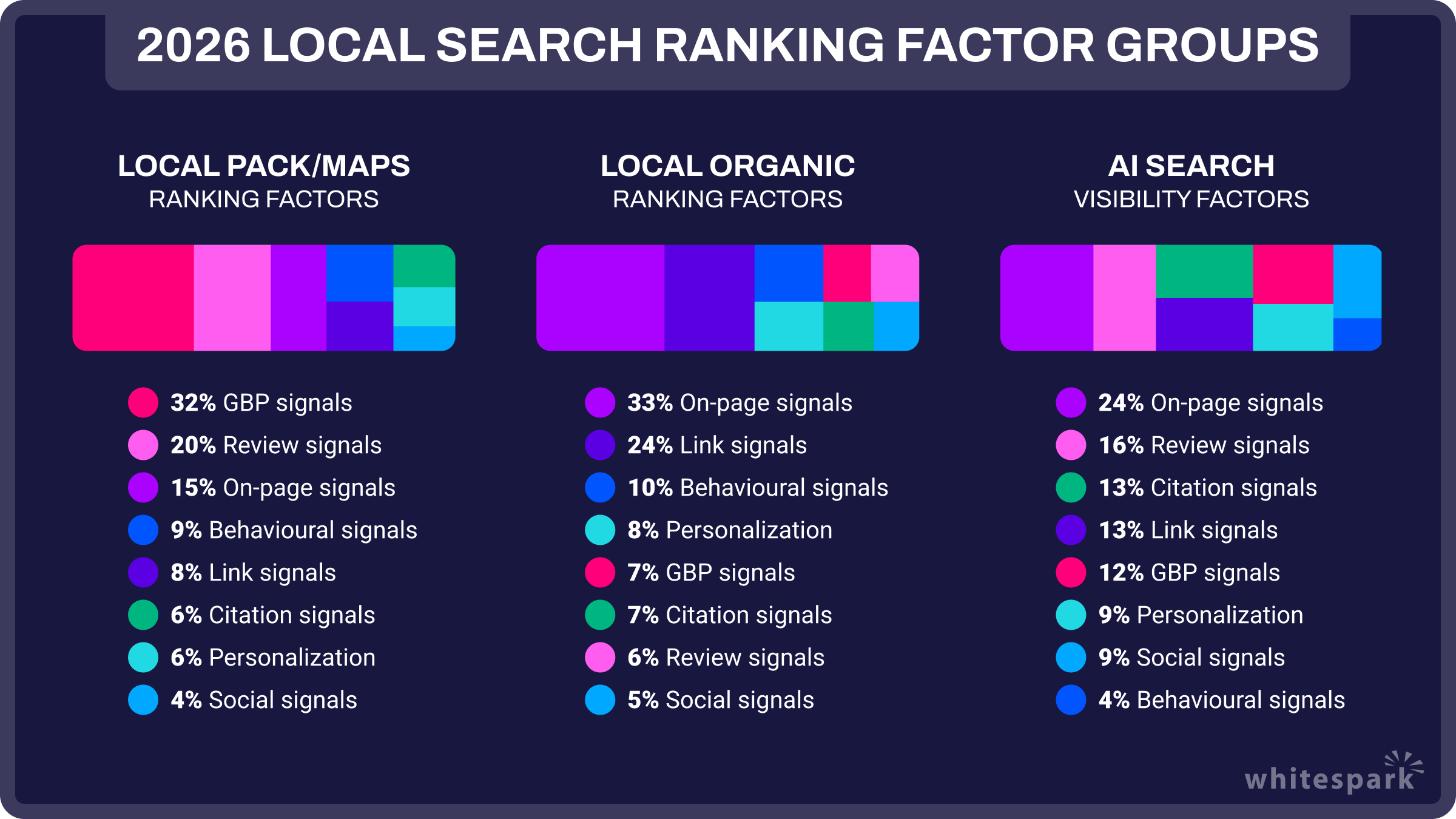
Local SEO in 2026 relies on Google evaluating three surfaces: Local Pack / Google Maps, Local Organic search results, and AI-generated local recommendations. Each surface uses a different weighting of signals, but the underlying data remains consistent across GBP, website quality, reviews, behavior, and off-site authority. Businesses with strong fundamentals tend to dominate all three surfaces. Businesses with gaps—such as inconsistent citations, poor review velocity, or thin location pages—struggle across all surfaces because Google cannot verify trust or relevance.
2026 Local Pack / Google Maps ranking factors
Maps results are influenced most heavily by GBP, reviews, relevance, and engagement. Below is a breakdown of each signal group.
Google Business Profile signals (32%)
GBP remains the most influential factor in Maps. Google evaluates categories, profile completeness, hours accuracy, attributes, photos, updates, and overall freshness. The primary category is a major relevance gate—choosing the wrong one severely impairs ranking potential.
Review signals (20%)
Review volume, velocity, recency, and sentiment heavily influence Map Pack visibility. Detailed reviews containing relevant keywords and real-world context reinforce topical relevance.
On-page signals (15%)
Your website reinforces GBP relevance. Strong service pages, location pages, schema, NAP consistency, and a well-structured internal linking strategy all strengthen ranking stability.
Behavioral signals (9%)
Clicks, calls, driving directions, and user engagement strengthen visibility because they reflect real-world interest.
Link signals (8%)
Local links and brand authority matter for prominence. Quality matters more than quantity.
Citation signals (6%)
Consistent NAP data across major directories helps Google validate business identity.
Personalization (6%)
User context—location, device, search history—affects which businesses appear.
Social signals (4%)
Growing but still low-weight; engagement strengthens brand authority.
2026 local organic ranking factors
Local Organic search relies more heavily on website quality, authority, and user satisfaction signals.
2026 AI search visibility factors
AI-driven local recommendations emerged as a distinct ranking surface in 2026. AI systems evaluate structured business data, sentiment patterns, content depth, and the business’s overall authority.
2025 vs. 2026: what actually changed
- AI visibility became its own category. 2025 treated AI as an emerging interface; 2026 measures it as a distinct surface.
- Review quality mattered more than raw count. Sentiment and context weigh heavier across Maps and AI.
- GBP activity rose in importance. Freshness and ongoing updates outperform “set it once” profiles.
- On-page semantic depth gained influence. Better topical completeness increases organic + AI visibility.
- Brand/social signals became more measurable. Mentions and engagement contribute more to prominence.
What changed in 2026
The biggest shift in 2026 is the formal inclusion of AI search visibility as a distinct outcome. Review quality, recency, and sentiment gained influence across all surfaces. GBP activity became more important than static completeness. On-page content quality and semantic depth increased in importance, particularly for AI visibility. Social and brand signals became more measurable contributors rather than background noise.
What didn’t change
Google Business Profile remains the primary driver of Map Pack rankings. On-page optimization remains the strongest driver of local organic visibility. Links continue to define authority. Reviews remain critical for trust and conversion. Distance still constrains rankings and cannot be overridden through SEO alone.
How to prioritize local SEO in 2026
Start with GBP fundamentals: correct categories, accurate hours, complete services, strong photos, and active review response. Next, build high-quality service and location pages that genuinely answer user questions and provide proof. Implement a consistent review acquisition process. Earn legitimate local and industry links through PR, community involvement, and partnerships. Clean up citations and eliminate duplicates. Finally, improve engagement with better visuals, clearer calls to action, and more helpful content that matches intent.
Final takeaway
The 2026 local SEO ranking factors reward businesses that demonstrate real-world credibility, consistent engagement, and clear relevance. AI has changed how results are delivered, but it has not changed what Google values. Businesses that invest in fundamentals—executed well and maintained consistently—continue to win across Maps, organic results, and AI-driven discovery.